
Flat roof installation is the process of designing, preparing, and applying a low-slope or completely level roofing system to a residential or commercial structure. Unlike pitched roofs, flat roofs rely on specialized waterproofing membranes, drainage layers, and insulation systems to protect a building from moisture intrusion and thermal stress. In Carmel, Indiana—where summers bring intense humidity and winters deliver significant freeze-thaw cycles—selecting the right flat roofing system is critical to long-term performance.
Carmel Roofing Solutions has served property owners across Hamilton County and the greater Indianapolis metro with professional flat roof installation services. Our crews understand the local building codes enforced by the City of Carmel Department of Community Services, the soil movement patterns common in Hamilton County’s clay-rich terrain, and the specific weather stressors that accelerate membrane degradation in central Indiana. Whether you own a modern mixed-use building on Range Line Road or a commercial warehouse near the US-31 corridor, we deliver durable, code-compliant flat roof systems built to last.
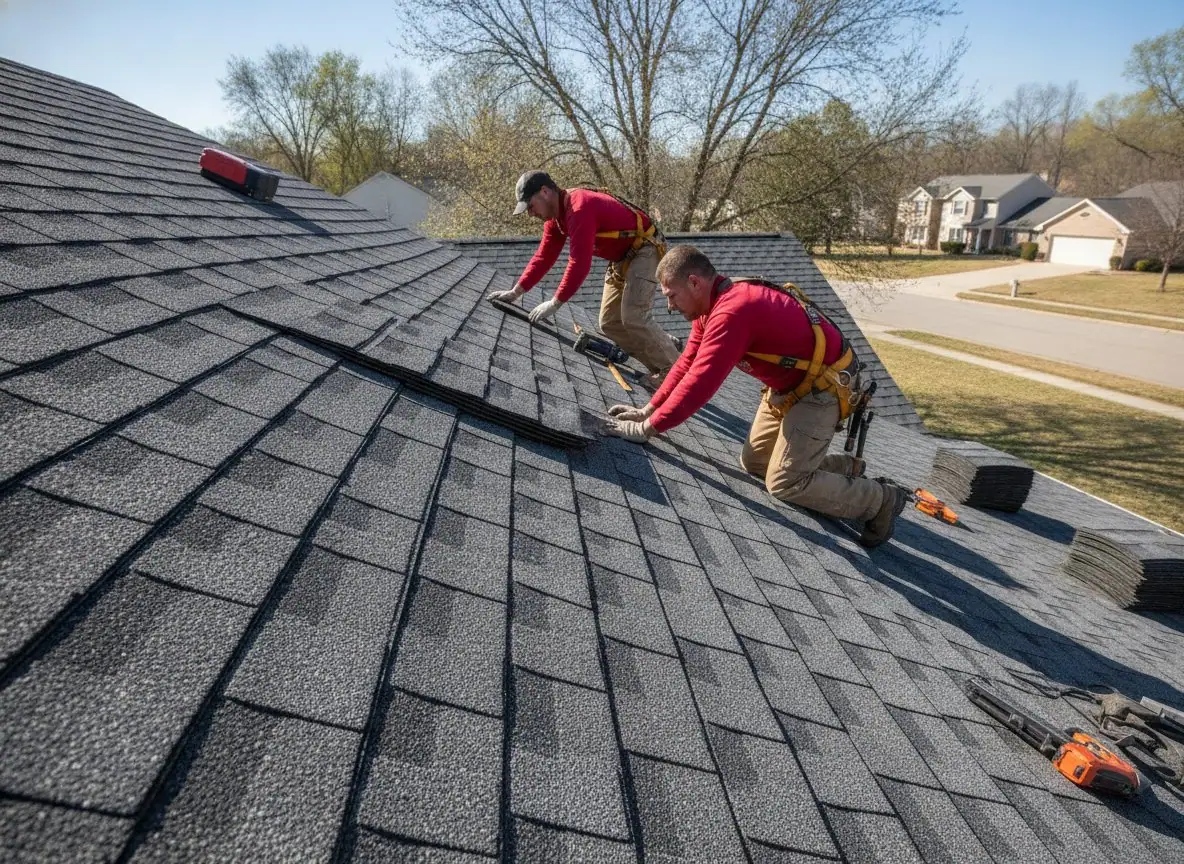
Understanding Flat Roof Installation
Flat roofing has a rich history dating back to ancient Mesopotamian architecture, where mud-brick buildings with flat, load-bearing rooftops were commonplace in arid climates. The modern flat roof system, however, evolved significantly through the 20th century with the introduction of built-up roofing (BUR) in the early 1900s, modified bitumen in the 1970s, and single-ply thermoplastic membranes—TPO and PVC—in the 1980s and 1990s. Today’s flat roof installation is an engineered process that balances waterproofing, insulation value, drainage efficiency, and structural load capacity.
In Carmel, IN, flat roofs are most commonly found on commercial office buildings, retail centers, restaurants, medical facilities, and light industrial properties. The rapid commercial development that has transformed Carmel over the past two decades—including the Arts & Design District, the Carmel City Center mixed-use development, and the expanding Meridian Corridor—has brought a large inventory of flat-roofed structures to the community. Many of these buildings were constructed between 2005 and 2020 and are now approaching their first major re-roofing or replacement cycle.
Read moreShow less
Flat roof installation involves several key components: a structural deck (typically steel, wood, or concrete), a vapor retarder layer, rigid board insulation (often polyisocyanurate, or “polyiso”), a cover board, and the waterproofing membrane itself. In Indiana, where the International Energy Conservation Code (IECC) sets minimum insulation requirements, polyiso boards must typically achieve an R-value of at least R-25 for commercial flat roofs. Proper drainage design is equally important—Carmel receives an average of 42 inches of precipitation annually, meaning a well-sloped internal drain and scupper system is not optional; it is essential.
A professional flat roof installation also accounts for rooftop penetrations such as HVAC equipment, plumbing vents, and electrical conduits—all of which require watertight flashing details. Understanding how to properly flash and integrate these elements into a continuous waterproofing system is what separates a lasting installation from one that leaks within its first year.
Learn more about our full Roof Installation services
Why Flat Roof Installation Is Needed in Carmel, IN
Freeze-Thaw Cycling on Hamilton County’s Clay Soils
Hamilton County’s soils are dominated by poorly drained, silty clay loams—particularly the Crosby-Brookston soil association that underlies much of western Carmel. These soils expand and contract significantly with moisture changes, causing subtle foundation movement that translates upward into parapet walls and roof decks. When a roof deck shifts even slightly, membrane seams and flashings are placed under repeated stress. Over a typical Carmel winter, the region experiences an average of 40 to 55 freeze-thaw cycles between November and March, each one expanding and contracting membrane materials by fractions of an inch. Cumulatively, this mechanical fatigue causes seam splits, flashing separations, and membrane cracking that require full system replacement rather than spot repair.
Heavy Snow Loads and Ice Damming
Carmel averages approximately 20 to 24 inches of snowfall per year, with significant storm events occurring regularly. The January 2019 polar vortex event brought temperatures as low as -20°F to the Indianapolis metro area, including Carmel, causing rapid contraction of roofing membranes and catastrophic splitting on older built-up roofing (BUR) systems across the city. Flat roofs with inadequate slope—less than the recommended ¼ inch per foot—allow standing water to accumulate beneath snow, adding structural loads exceeding 20 pounds per square foot in extreme events. New installations must be engineered to meet these load requirements under the Indiana Residential Code and the Indiana Building Code.
Intense Summer UV and Heat Island Effect
Carmel’s urban development, particularly around the Meridian Street corridor, Pennsylvania Parkway, and the US-31 expansion zone, has created measurable urban heat island pockets where rooftop surface temperatures can reach 160°F to 180°F on summer afternoons. Traditional dark EPDM membranes absorb this heat aggressively, accelerating oxidation and brittleness. In neighborhoods like Village of West Clay and Clay Terrace’s commercial surroundings, building owners are increasingly choosing white TPO or PVC membranes, which reflect up to 85% of solar radiation and reduce cooling costs by an estimated 10–15% annually.
Aging Commercial Building Stock
A significant portion of Carmel’s commercial flat roofing stock was installed during the construction boom of 2000–2012, when the city’s population grew from roughly 38,000 to over 79,000 residents. Many of these early 2000s EPDM and modified bitumen systems are now 15 to 22 years old—well past their typical 15-year warranty periods. Property owners in the Carmel Science and Technology Park, along College Avenue’s commercial strip, and in the Keystone Parkway corridor are increasingly finding that patch repairs are no longer cost-effective and that full flat roof replacement is the only responsible path forward.
Explore our Roof Replacement services for aging flat roof systems
Free, no-obligation estimates
Talk to Carmel Roofing Solutions
Tell us what you need and we’ll take it from there.
Signs You Need Flat Roof Installation in Carmel
Structural and Membrane Warning Signs
- Visible membrane blistering, bubbling, or alligatoring across 30% or more of the roof surface
- Open seam splits or lap separations longer than 6 inches that recur after repeated repairs
- Ponding water that remains standing more than 48 hours after rainfall
- Visible sagging or deflection in the roof deck, indicating potential structural compromise
Interior Warning Signs
- Water stains on interior ceilings or walls directly below the roofline
- Mold or mildew odor in upper-floor or ceiling spaces
- Peeling paint or drywall damage near rooftop penetration points such as HVAC curbs or vent pipes
Energy Performance Warning Signs
- Unexplained spikes in heating or cooling costs, suggesting wet or compressed insulation layers
- Uneven interior temperatures across upper-floor spaces, indicating thermal bridging through failed insulation
Urgency Indicators
If you are experiencing active interior water intrusion, visible deck rot, or structural deck deflection visible from inside the building, contact Carmel Roofing Solutions immediately at (317) 597-6620. These conditions can escalate to emergency situations quickly, particularly before a Carmel winter storm season.
Schedule a professional Roof Inspection to assess your flat roof
Our process
Our Flat Roof Installation Process in Carmel, IN
Every flat roof installation Carmel Roofing Solutions completes follows a structured, transparent process designed to minimize disruption to your property and maximize system longevity.
- 01
Initial Consultation and Roof Assessment (Days 1–3)
Our project manager visits your property, performs a visual inspection, and reviews building plans or as-built drawings where available. We use infrared moisture scanning when warranted to identify wet insulation zones beneath the existing membrane—a service e
- 02
Permit Application and City Coordination (Days 4–10)
We submit all required permit applications to the City of Carmel Department of Community Services. Carmel requires roofing permits for commercial projects and for residential projects involving structural changes. We manage this process entirely, including coo
- 03
Tear-Off and Deck Preparation (Days 1–2 of Installation)
Our crews remove the existing roofing membrane and insulation down to the structural deck. All decking is inspected for rot, delamination, or corrosion. Damaged deck sections are replaced before any new materials are applied. In Carmel’s freeze-thaw environmen
- 04
Insulation Installation (Day 2–3 of Installation)
Polyisocyanurate insulation boards are mechanically fastened or adhered to the deck in two layers with staggered joints to eliminate thermal bridging. We design for a minimum R-25 value per Indiana IECC requirements, with upgrades available for enhanced energy
- 05
Membrane Installation (Days 3–5 of Installation)
The selected membrane system—TPO, PVC, EPDM, or modified bitumen—is installed by certified applicators. All seams are heat-welded or chemically bonded per manufacturer specifications. Flashings are installed at all penetrations, parapet walls, and transitions.
- 06
Drainage and Finishing Details (Day 5–6)
Internal drains, scuppers, and overflow drains are inspected, tested, and adjusted to ensure proper water flow. Edge metal, coping caps, and sealants are installed to complete the system.
- 07
Final Inspection and Walkthrough (Day 7)
We conduct a detailed final inspection, document the completed installation with photographs, and walk the property owner through the completed system. City inspection is coordinated and completed before project closeout.
Flat Roof Installation Methods and Approaches
TPO (Thermoplastic Polyolefin) Single-Ply Membrane
TPO is the most widely specified flat roofing membrane in Carmel’s commercial market. Its white, highly reflective surface is ideal for the urban heat island conditions found along Range Line Road and the Keystone Parkway commercial corridor. TPO is heat-welded at all seams, creating a watertight bond stronger than the membrane itself. It is well-suited for new construction and full replacement projects and carries manufacturer warranties of 15 to 30 years depending on thickness (60 mil, 80 mil).
EPDM (Ethylene Propylene Diene Monomer) Rubber Membrane
EPDM is a proven, cost-effective option for larger low-slope roofs where budget is a priority. Available in 45 mil and 60 mil thicknesses, EPDM is fully adhered, mechanically attached, or ballasted. In Carmel’s northern neighborhoods near Westfield Boulevard, where older flat-roofed warehouse structures predominate, EPDM replacement remains common due to its familiarity and repairability.
Modified Bitumen (Mod-Bit)
Modified bitumen systems—either torch-applied or self-adhered—offer excellent performance in Carmel’s freeze-thaw conditions due to their inherent flexibility at low temperatures. They are particularly suitable for roofs with complex geometry, multiple penetrations, or extensive parapet walls, such as those found in Carmel’s older downtown commercial buildings.
PVC (Polyvinyl Chloride) Membrane
PVC membranes offer superior chemical resistance, making them the preferred choice for restaurants, food processing facilities, and healthcare buildings in Carmel where grease exhaust or chemical exposure is a concern. PVC is heat-welded and carries performance characteristics similar to TPO.
Built-Up Roofing (BUR)
Traditional BUR systems, consisting of multiple layers of bitumen and reinforcing fabrics, remain an option for specific commercial applications. While less common in new installations, BUR is occasionally specified for retrofit projects requiring compatibility with existing system layers.
Flat Roof Installation Cost in Carmel, IN
Flat roof installation costs in Carmel, Indiana, vary based on roof size, membrane type, insulation specification, deck condition, and project complexity. The following ranges are based on current material and labor pricing in the Hamilton County market.
- TPO Single-Ply (60 mil, fully adhered): $7.50–$11.00 per square foot installed
- EPDM Single-Ply (60 mil, fully adhered): $6.50–$9.50 per square foot installed
- Modified Bitumen (torch-applied, 2-ply): $7.00–$10.50 per square foot installed
- PVC Single-Ply (60 mil, fully adhered): $8.00–$12.00 per square foot installed
- Built-Up Roofing (4-ply BUR): $8.50–$13.00 per square foot installed
Key Cost Factors for Carmel Properties
- Tear-off and disposal: Add $1.50–$2.50 per square foot if existing roofing must be removed and disposed of at an Indiana-licensed facility.
- Deck repairs: Rotted or damaged decking adds $3.00–$8.00 per square foot for replacement materials and labor.
- Insulation upgrades: Upgrading to R-30 or R-35 polyiso adds $0.75–$1.50 per square foot over code minimum.
- Rooftop penetrations: Complex HVAC curb flashings, skylight surrounds, and drain replacements add $200–$800 per penetration.
- Permit fees: City of Carmel commercial roofing permits typically range from $150 to $450 depending on project valuation.
Read moreShow less
A typical 5,000-square-foot commercial flat roof replacement in Carmel using a 60 mil TPO system will cost between $37,500 and $55,000 fully installed, including tear-off, insulation, membrane, flashings, and permit.
Protect your investment with our Roof Maintenance programs
Neighborhoods We Serve in Carmel, IN
Arts & Design District / Old Town Carmel
The Arts & Design District along Main Street and the surrounding Old Town area features a mix of early-20th-century commercial buildings and newer mixed-use structures built during Carmel’s urban redevelopment push of the 2010s. Older buildings in this district often have BUR systems dating to the 1980s and 1990s that require complete tear-off and replacement, while newer structures may need early membrane repairs due to construction-era installation shortcuts.
Village of West Clay
This master-planned community on Carmel’s western side features a traditional neighborhood design with some commercial flat-roofed structures in its town center. Buildings here, predominantly constructed between 2002 and 2015, are now entering their first major maintenance cycle. Clay soil movement is particularly pronounced in this area, making flashing integrity a recurring concern.
Meridian Corridor / US-31 Commercial Zone
The densely developed commercial corridor along US-31 from 96th Street northward through Carmel hosts a large concentration of office parks, medical facilities, and retail centers—almost all with flat or low-slope roofing systems. Heat island temperatures in this zone make reflective TPO or PVC membranes the preferred specification for energy compliance and comfort.
Carmel Science and Technology Park
This light industrial and office campus near Carmel Drive features large footprint flat-roofed buildings that require high-capacity drainage systems and robust insulation to meet both energy codes and operational requirements.
Flat Roof Maintenance Tips for Carmel Property Owners
A properly installed flat roof in Carmel, IN can last 20 to 30 years with consistent preventive maintenance. Follow these location-specific tips to maximize your system’s lifespan.
- Inspect drains every spring and fall. Carmel’s autumn leaf fall from abundant mature oak and maple trees clogs internal drains and scuppers rapidly. Clear all drainage points before the November rain season begins.
- Remove standing water within 48 hours of rain. Ponding water accelerates membrane degradation and adds structural load. Use a rubber squeegee or soft push broom—never metal tools—on membrane surfaces.
- Inspect flashings after every significant storm. Hamilton County experiences 5–8 severe thunderstorm events annually between April and September. Post-storm flashing inspection catches separations before they become interior leaks.
- Clear snow loads carefully after significant snowfall events. After storms delivering 6 or more inches—common in Carmel during January and February—remove accumulated snow with a roof rake to prevent overload.
- Schedule a professional infrared moisture scan every 3–5 years. Wet insulation beneath a membrane surface is invisible to the naked eye but dramatically reduces R-value and accelerates deck rot.
- Keep HVAC technicians and other rooftop tradespeople informed. Require all rooftop contractors to use walk pads and avoid dragging equipment across bare membrane surfaces.
- Document all repairs with photos and dates. A maintenance log strengthens warranty claims and helps roofing contractors assess cumulative wear at future inspection visits.
Learn about our professional Roof Maintenance plans for Carmel properties
Why Choose Carmel Roofing Solutions for Your Flat Roof Installation
Carmel Roofing Solutions is a locally focused roofing company built around the specific needs of property owners in Carmel, IN, and the surrounding Hamilton County communities. Our team works exclusively in central Indiana, which means we understand the exact climate stressors, building codes, soil conditions, and commercial development patterns that affect roofing decisions in this market.
We navigate City of Carmel permitting requirements on your behalf, ensuring your installation is fully code-compliant and passes inspection without delays. Our flat roof installation crews are trained and certified in the installation of TPO, EPDM, PVC, and modified bitumen systems from leading manufacturers, which allows us to offer manufacturer-backed warranties that standalone contractors cannot access.
Read moreShow less
We serve not just Carmel, but also Westfield, Fishers, Noblesville, Zionsville, and Indianapolis, giving us the project volume and supplier relationships to keep material costs competitive for our customers. Every project begins with a thorough consultation, includes transparent written estimates, and closes with a documented final inspection.
For commercial roofing emergencies, our team is available for rapid response. Call (317) 597-6620 any time.
Explore our full Commercial Roofing capabilities
FAQ
Frequently Asked Questions: Flat Roof Installation in Carmel, IN
How much does flat roof installation cost in Carmel, IN?
Flat roof installation in Carmel typically costs between $6.50 and $13.00 per square foot installed, depending on membrane type, insulation specification, and deck condition. A 3,000 square foot commercial flat roof replacement commonly runs between $22,000 and $40,000 fully installed, including permit, tear-off, insulation, and new membrane.
How long does a flat roof installation take in Carmel?
Most commercial flat roof installations in Carmel are completed in 3 to 7 business days for roofs up to 10,000 square feet, weather permitting. Permit processing through the City of Carmel Department of Community Services typically adds 5 to 10 business days to the overall project timeline. We schedule installations to avoid periods of forecast rain.
What is the best flat roof membrane for Carmel’s climate?
For most Carmel commercial properties, 60 mil or 80 mil TPO is our top recommendation. Its reflective white surface addresses the urban heat island effect along the Meridian Corridor and US-31 zone, its heat-welded seams perform well through Hamilton County’s 40-plus annual freeze-thaw cycles, and its 20 to 30-year manufacturer warranty provides strong long-term value. For roofs with chemical exposure risks—restaurants, healthcare facilities—PVC is the preferred alternative.
Do I need a permit for flat roof installation in Carmel, IN?
Yes. The City of Carmel requires roofing permits for commercial roofing projects and for residential projects that involve structural changes or additions to the roof assembly. Carmel Roofing Solutions handles all permit applications and city inspection coordination on your behalf.
How do I know if my flat roof needs replacement versus repair?
A professional infrared moisture scan and visual inspection are the most reliable tools for making this decision. Generally, if more than 25% of your roof’s insulation is wet, if seam failures are widespread across multiple areas, or if the membrane is more than 20 years old with documented repair history, full replacement is typically more cost-effective than continued patching. Schedule a Roof Inspection to get a professional assessment.
Can flat roof installation be done in Carmel’s winter months?
Certain membrane systems—specifically self-adhered modified bitumen and mechanically attached TPO—can be installed in temperatures as low as 25°F to 35°F with proper precautions. However, we generally recommend scheduling flat roof installations between April and October in Carmel to avoid complications from ice, snow, or extreme cold that can affect adhesive performance and membrane flexibility. Emergency installations can be managed year-round.
Do you serve areas outside of Carmel, IN?
Yes. Carmel Roofing Solutions provides flat roof installation services throughout Hamilton County and the greater Indianapolis metro, including Westfield, Fishers, Noblesville, Zionsville, Whitestown, Indianapolis, Lawrence, Speedway, Cicero, and McCordsville.
What warranty is available on a new flat roof installation?
Warranty terms depend on the membrane manufacturer and system specification chosen. Standard manufacturer warranties for TPO and PVC systems range from 15 to 30 years when installed by a certified contractor. Workmanship warranties for installation labor are provided separately. Ask your Carmel Roofing Solutions project manager about specific warranty options for your chosen system during your consultation.
Get Your Free Flat Roof Installation Estimate in Carmel, IN
If you own or manage a property in Carmel, IN, and your flat roof is showing signs of wear, age, or active leakage, now is the time to act. Delaying flat roof replacement in Hamilton County’s demanding climate only leads to more extensive deck damage, interior moisture intrusion, and higher overall project costs.
Carmel Roofing Solutions is ready to provide a thorough, no-obligation flat roof assessment and written installation estimate. We work with property owners, building managers, and commercial tenants throughout Carmel and the surrounding communities to deliver durable, code-compliant flat roofing systems at competitive pricing.
Call us today at (317) 597-6620 to schedule your free consultation, or reach out through our website to request an estimate. Our team is ready to protect your property with a flat roof system built for Indiana’s climate.
Contact Carmel Roofing Solutions to request your free flat roof estimate
Get in touch
Find roofing help near you
Request a free estimate online or give us a call — our team will follow up quickly.
- Call us(317) 597-6620
- Visit550 Congressional Blvd suite 250, Carmel, IN 46032
- HoursMon-Sun: 7:00 am – 7:00 pm